Monday, September 26, 2022

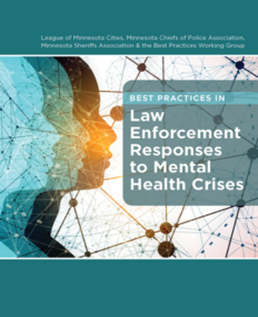
Best Practices in Law Enforcement Responses to Mental Health Crises


Many law enforcement agencies are experiencing a high demand for crisis services but have no clear answers for what to do about it. 

Recent statistics show about 20% of adults and 50% of adolescents in the United States live with a mental illness. Estimates also show between 6% and 10% of all police calls involve someone with a serious mental illness. These calls can all too often end in tragedy or people with a mental illness end up in jail. Studies have also estimated that up to 25% of all police shootings in recent years have involved people with a mental illness.

The League of Minnesota Cities recently partnered with the Minnesota Chiefs of Police Association and the Minnesota Sheriffs Association to develop a guide for best practices in mental health crisis response among law enforcement personnel. The guide’s content was written by attorney Bill Everett, principal of Everett Law LLC and a former police officer, and is based on a series of meetings with key law enforcement and mental health professionals from all areas of the state.

The best practices guide outlines the current response challenges faced by agencies and identifies realistic solutions and approaches for addressing those challenges based on a set of mutually agreed-upon guiding principles.

Download the guide, “Best Practices in Law Enforcement Responses to Mental Health Crises” (pdf)

Send your questions or comments to tstille@lmc.org or call me at (651) 215-4051.


Remember: Responder Safety = Public Safety

In the meantime, stay safe and be careful - 

Tracy

Monday, September 12, 2022

The Power of Peer Support: Low-Cost Peer Support Training Available This Fall

A guest post by LMCIT Public Safety Program Coordinator Lora Setter, lsetter@lmc.org

“When we can talk about our feelings, they become less overwhelming, less upsetting, and less scary. The people we trust with that important talk can help us know that we are not alone.” - Fred Rogers 


This quote from Mr. Rogers captures the spirit of public safety peer support. Because of the nature of their job duties, public safety professionals see and do things that are outside of the normal human experience. They are routinely exposed to trauma and death, which can take its toll on their mental health. Talking to a specially trained peer, can provide the psychological first aid needed to minimize or help negate the impact of those experiences. 

Peer support personnel are trained in specific knowledge areas such as active listening, confidentiality, suicide prevention, chemical dependency behaviors, signs and symptoms of PTSD, basic wellness, and positive relationship-building. Talking to a trained peer can provide trusted communication, encouragement, and an increased understanding of the emotional impact of critical incidents and traumatic events. When needed, peer support team members can afford colleagues with resources and referrals for a higher level of support before a psychological illness may become career-ending. 

Public safety departments are facing hiring and retention challenges, which make it even more important to create supportive, caring organizations that focus on employee wellness. The League of Minnesota Cities Insurance Trust (LMCIT) encourages public safety entities to invest in the vital resource of peer support in the prevention, recognition, and support of public safety mental health. To help promote peer support initiatives, LMCIT has created a Peer Support Advisory Board made up of police, fire, and mental health professionals. The board provides recommendations and assists with the prioritization of LMCIT initiatives regarding peer support. 

One of the Board’s initiatives is to provide peer support training to public safety entities across the state. To aid in that initiative, this fall the LMCIT is hosting Peer Support Training at three locations: 

  • Nov. 1-2 — Cottage Grove
  • Nov. 3-4 — Marshall
  • Nov. 29-30 — Waite Park
Fee: $100 for League of Minnesota Cities Insurance Trust members; $450 for non-members (fee includes lunch and refreshments)

A survey of public safety leaders across Minnesota showed that both police and fire leaders view peer support programs as a helpful public safety mental health strategy. They see the power in peer support. 

For more information about this fall’s peer support training and to register, visit the League’s Peer Support Training webpage.

Wednesday, July 27, 2022

Join Us for the Police Force Science Workshop


During this era of police reform, de-escalation training is one of many hot topics that are being discussed and highly embraced by law enforcement professionals as well as the community. De-escalation and response to resistance techniques have the potential to help prevent the need to use force in many encounters between police and community members.    

As with many issues in law enforcement, the entire concept of de-escalation and the use of force is complex. Every day, law enforcement officers across Minnesota and the nation deal with challenging encounters on the job. Most of these incidents result in successful and peaceful non-forceful resolutions, although some don’t always go smoothly — especially when dealing with a combative and uncooperative individual.  

The International Association of Chiefs of Police (IACP) and the Center for Police Research and Policy (UC) recently published guidelines on how to begin evaluating an agency’s de-escalation practices. These guidelines were developed using versions of the Integrating Communications, Assessment, and Tactics (ICAT) training program by a multi-disciplinary group including police officers, attorneys, and subject-matter experts and are designed for police leaders interested in assessing and enhancing their agency’s capacity to implement, evaluate, and monitor de-escalation training and policies.  

As a police officer for many years, I can attest that police officers would like to avoid the need to use force whenever possible, although there are times when force is necessary to resolve a situation and avoid an escalation of an incident which could lead to a dangerous outcome including a critical incident.

An important component of effective de-escalation of an incident is training, and a cornerstone of good training is stressing the importance of communication that involves the incorporation of physical practice and scenario-based role-playing exercises in all areas of law enforcement operations.  

This fall, the League of Minnesota Cities Insurance Trust (LMCIT) is sponsoring a workshop developed by the Force Science Institute that will teach police officers how to best handle these critical situations —while keeping both officers and the public safe.  

Just recently, Force Science achieved national certification and international recognition for their Force Science courses thru the National Certification Program (NCP) of the International Association of Directors of Law Enforcement Standards and Training (IADLEST). The course will cover many aspects of human psychology, police tactics and techniques, and negotiation strategies.

Register Today!

Registration for Force Science Institute Realistic De-escalation Training workshop is now open at lmc.org/22policeworkshop. This workshop has been approved for eight hours of POST credits for conflict management/mediation.

This workshop will be held at two locations, and the course fee has been reduced to $50 for LMCIT members (the fee for non-members is $295).

Additional information can be found here and registration questions can be directed to Carlie Derouin, event coordinator, at (651) 281-1258 or cderouin@lmc.org.

If you have any questions about the content of this training opportunity, you may contact me at tstille@lmc.org or give me a call at (651) 215-4051.


Remember: Responder Safety = Public Safety

In the meantime, stay safe and be careful - 

Tracy